.png?width=1500&height=1043&name=light-logo.v1%20(1).png)
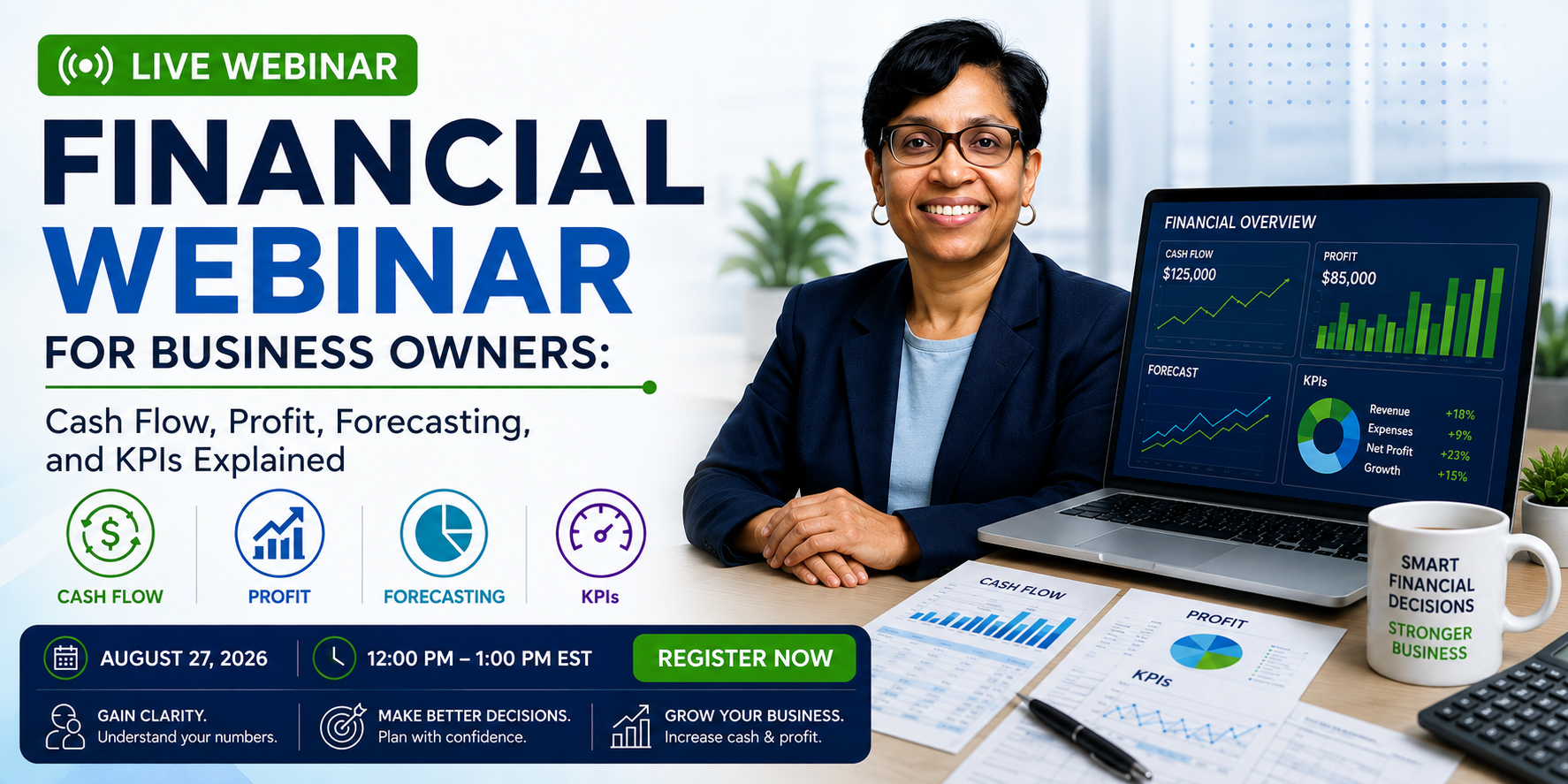
Financial Webinar for Business Owners: Cash Flow, Profit, Forecasting, and KPIs Explained

Most business owners can tell you what their bank balance is today. Far fewer can tell you what it will be in 90 days, or why profit on paper doesn't always match cash in the account. That gap is exactly what our financial webinar for business owners is designed to close.
This session brings together four topics that are usually taught separately — cash flow, profit, forecasting, and KPIs — and shows how they work as one system. If you've ever felt like your numbers are technically "fine" but you're still not sure where you stand, this webinar was built for you.
Webinar Details
THE 5 FINANCIAL BLIND SPOTS COSTING GROWING BUSINESSES CASH AND PROFIT
- Date: August 27, 2026
Time: 12:00–1:00 p.m. EST
Format: Live online webinar
Presented by: Pamela Murray, MBA, Principle
Best for: Business owners who want greater visibility into cash flow, profitability, and future financial needs.
The Problem: Numbers Without a Clear Picture
Many business owners run their companies using a mix of gut feelings and whatever the bank balance shows that day. Bookkeeping is often accurate. The tax filings are done. But there's no connected view of what the numbers actually mean for decision-making.
This shows up in a few common ways:
None of this means the business is in trouble. It usually means the financial picture hasn't been connected into something usable for planning.
Why This Matters for Business Owners
Cash flow, profit, forecasting, and KPIs aren't four separate reports — they're four views of the same business, and each one answers a different question:
When these are looked at in isolation, owners end up making decisions on incomplete information. When they're connected, decisions get faster and more confident — not because the business changed, but because the visibility did.
Why a Profitable Business Can Still Run Into Cash Trouble
This is one of the most common points of confusion for business owners, so it's worth walking through with a simple example.
Say a company reports $40,000 in profit for the month. On paper, that looks healthy. But if most of that revenue is sitting in unpaid invoices and customers typically take 60 days to pay, the business could still struggle to cover payroll, rent, or vendor bills in the meantime. The profit is real. It just hasn't turned into cash yet.
This is the difference between profit and cash flow in practice:
None of this means the business made a mistake. It means profit and cash flow needed to be looked at together, not as substitutes for each other.
Key Points and Framework
Our financial planning webinar for business owners walks through a practical framework for connecting these four pieces:
1. Cash Flow: The Timing Layer
Cash flow isn't just "how much money is in the bank." It's the timing of when money moves in and out. A profitable business can still run into trouble if cash isn't arriving fast enough to cover what's going out.
2. Profit: The Model Layer
Profit tells you whether the underlying business model makes sense — whether pricing, costs, and volume are working together the way they should. This is different from cash flow, and confusing the two is one of the most common financial blind spots for business owners.
3. Forecasting: The Forward Layer
A forecast takes what's happening now and projects it forward, so decisions can be made before a problem shows up — not after. Even a rough 90-day forecast is enough to flag a tight month before it arrives, giving you time to adjust rather than react. This is what turns financial reporting from a rearview mirror into a windshield.
4. KPIs: The Signal Layer
Not every number deserves equal attention. KPIs are the small set of metrics that actually move the needle for your specific business — the ones worth checking regularly because they tell you something is changing before it becomes obvious.
Together, these four layers give business owners something a monthly financial statement alone can't: a working system for financial clarity.
What Makes a KPI Useful
A useful KPI does one thing well: it gives you an early signal, not just a historical fact. The right KPIs depend on the business — a service firm and a product-based business won't track the same numbers — but a few examples show the range:
Most businesses don't need to track dozens of metrics. Somewhere between three and five well-chosen KPIs, reviewed consistently, will tell you more than a stack of reports reviewed occasionally.
Practical Next Steps
You don't need to overhaul your entire financial process to get value from this. Start here:
Small, consistent habits here matter more than a perfect system.
The AEG Perspective
At Accounting Expert Group, we see the same pattern across almost every business we work with: the financial data exists, but it is not connected in a way the owner can use to make decisions. That's not a bookkeeping problem — it's a clarity problem.
Our approach as a business financial advisor and CFO advisory resource is to build that connection: turning cash flow, profit, forecasting, and KPIs into one clear picture instead of four disconnected reports. When business owners can see how these pieces fit together, decisions get easier — not because the business got simpler, but because the noise got removed.
This is the same thinking we bring to our cash flow consulting and business financial planning work with clients: clarity first, then confidence, then better decisions.
Join the Webinar
If you're ready to see how cash flow, profit, forecasting, and KPIs fit together in your own business, join us for this financial webinar for business owners.
Whether you're looking to sharpen a financial process that's already working or you're starting from scratch, this session will give you a clear, practical starting point.
Reserve your spot today and take the first step toward real financial clarity — not just more reports.