.png?width=1500&height=1043&name=light-logo.v1%20(1).png)

real estate accounting services
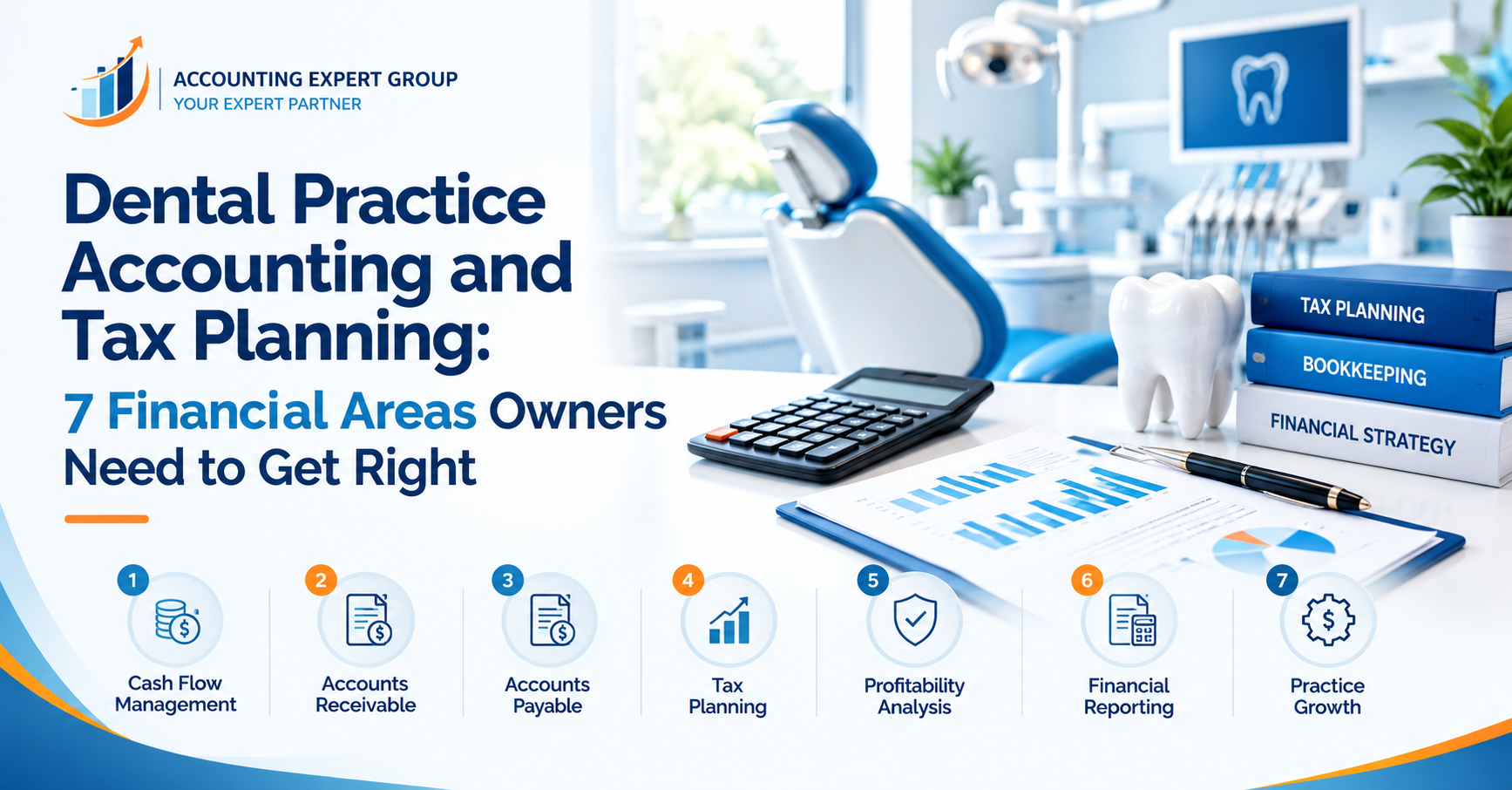

Running a dental practice means managing patient care, staff, equipment, and a business often all at once. With so much attention going toward clinical work and day-to-day operations, the financial side of the practice can end up on autopilot.
Dental practices are small businesses, but their revenue cycle, labor structure, equipment investment, and overhead patterns require specialized accounting services for dental practices rather than a generic bookkeeping setup.
Dental practices deal with a specific mix of financial factors that generic bookkeeping and tax approaches often overlook:
When these details aren't tracked with precision, it becomes difficult to know the practice's true profitability, plan for tax obligations, or make informed decisions about growth, such as adding a hygienist or upgrading equipment.
A dental practice can be busy and still be financially uncertain. Full schedules don't automatically mean strong margins, especially when insurance reimbursements lag or overhead costs rise without notice.
Clear, accurate accounting gives practice owners more than a general sense that things are going well it provides specific financial information they can use to evaluate profitability, cash flow, and operating trends.
That information supports decisions about whether to bring on an associate, when to upgrade equipment, and how to prepare for tax obligations without unnecessary surprises.
A dental practice should be able to distinguish gross production from contractual adjustments, adjusted production, and actual collections. Patient balances and insurance balances should also be monitored separately. This makes it easier to identify aging claims, reimbursement delays, uncollected patient responsibility, unusual or increasing adjustments, and deposits that haven't been properly recorded.
A dental practice may run production and collection reports through Dentrix, Eaglesoft, Open Dental, or another practice management system, while the general ledger is maintained in QuickBooks or a similar platform and those systems don't automatically agree. Practice-management reports, merchant deposits, insurance payments, patient payments, refunds, and bank activity should be reconciled regularly. A strong production report doesn't necessarily mean the same amount was collected or deposited.
Dental equipment can create a significant cash-flow commitment and a potentially significant tax benefit. The appropriate treatment depends on the type of equipment, how it is financed, when it is placed in service, the practice’s taxable income, available depreciation provisions including Section 179 and any applicable special depreciation allowance—and applicable state rules. Equipment decisions should be evaluated based on the practice’s clinical and business needs, financing, cash flow, and overall tax position not solely on the availability of a deduction.
Staff wages, benefits, payroll taxes, bonuses, and associate compensation should be recorded separately so the owner can understand total labor cost. The practice should also confirm that associates and other workers are properly classified. Whether a worker is an employee or an independent contractor depends on the actual working relationship, including behavioral control, financial control, and the type of relationship between the parties not only the compensation formula, contract title, or tax form issued.
Owner payments should be recorded based on the practice's entity structure. Salary, distributions, draws, reimbursements, benefits, and shareholder or partner loans are not interchangeable, and improperly categorizing these transactions can distort practice profitability and create payroll or tax issues. This is closely tied to keeping personal and practice expenses separate in the first place especially in owner-operated practices, where the two can blend together and make it harder to substantiate business deductions if the practice’s tax return is ever examined or the transactions are questioned.
Many sole proprietors, partners, and S corporation shareholders may need estimated-tax payments when withholding alone isn't sufficient, since income tax is generally a pay-as-you-go obligation and underpayment can result in penalties. Reviewing projected practice income, owner compensation, withholding, estimated payments, and available deductions during the year and setting aside tax funds as income is earned is one of the most practical tax habits a practice can build, rather than waiting until the return is prepared.
A meaningful monthly review goes beyond the profit and loss statement. It gives practice owners a clearer view of financial performance, cash flow, and operational trends while there is still time to respond.
A monthly dental practice review may include:
Reviewing these items monthly, rather than waiting until tax time, can help identify overhead increases, reimbursement issues, collection trends, or potential cash-flow gaps while there is still time to respond.
This type of recurring review also gives practice owners more dependable information for decisions about staffing, compensation, equipment, growth, and owner distributions.
For dental practice owners looking to strengthen their financial footing:
At Accounting Expert Group, we believe dental-practice accounting should connect four areas: the practice-management system, bank and credit-card activity, payroll and compensation, and year-round tax planning.
That means reconciling collections to deposits, reviewing patient and insurance receivable trends from practice-management reports, tracking payroll and overhead, recording equipment and debt correctly, and maintaining an updated view of cash and tax obligations.
The objective is to give the practice owner dependable information for decisions about staffing, compensation, equipment, growth, and owner distributions not merely financial statements prepared after the decisions have already been made.
Core accounting principles are the same, but a generic bookkeeping setup may not separately track production, contractual adjustments, collections, patient and insurance receivables, provider compensation, equipment, and tax-sensitive owner transactions. Without that additional detail, the reports may be technically complete but less useful for understanding profitability, cash flow, and practice performance.
Insurance payments may arrive after the service date and may include contractual adjustments, partial payments, denials, or other differences from the original amount billed. Tracking gross production, contractual adjustments, collections, and outstanding patient and insurance balances is essential for understanding collection performance, receivable trends, cash flow, and reimbursement issues.
A monthly review should generally include collections, adjusted production, accounts-receivable aging, cash, payroll and benefits, supplies, lab costs, debt payments, owner distributions, profitability, and projected tax obligations. The exact measures should reflect the practice's size, payer mix, provider structure, and number of locations.
No. Whether an associate dentist is an employee or an independent contractor depends on the actual working relationship, including behavioral control, financial control, and the type of relationship between the parties not only the compensation formula, contract title, or tax form issued.
The practice should maintain current books, update the owner's tax projection during the year, compare projected liability with withholding and estimated payments, and maintain a designated tax reserve. The amount should be based on the owner's complete tax situation rather than a generic percentage.
Schedule a dental-practice accounting consultation to evaluate your current accounting and reporting process and identify financial information that may be missing or difficult to see.
Accounting Expert Group helps dental practices build current, dependable accounting and tax-planning processes that support better decisions about staffing, equipment, owner compensation, and growth.
Schedule a dental-practice accounting consultation to identify the financial information your current process may be missing.
Schedule a Dental Accounting Consultation
This article is for general educational purposes and is not a substitute for accounting, tax, legal, employment, payroll, or HIPAA advice tailored to a particular practice. The appropriate treatment depends on the practice’s facts, entity structure, applicable law, and current guidance.