.png?width=1500&height=1043&name=light-logo.v1%20(1).png)

small bookkeeping services
outsourced bookkeeping services
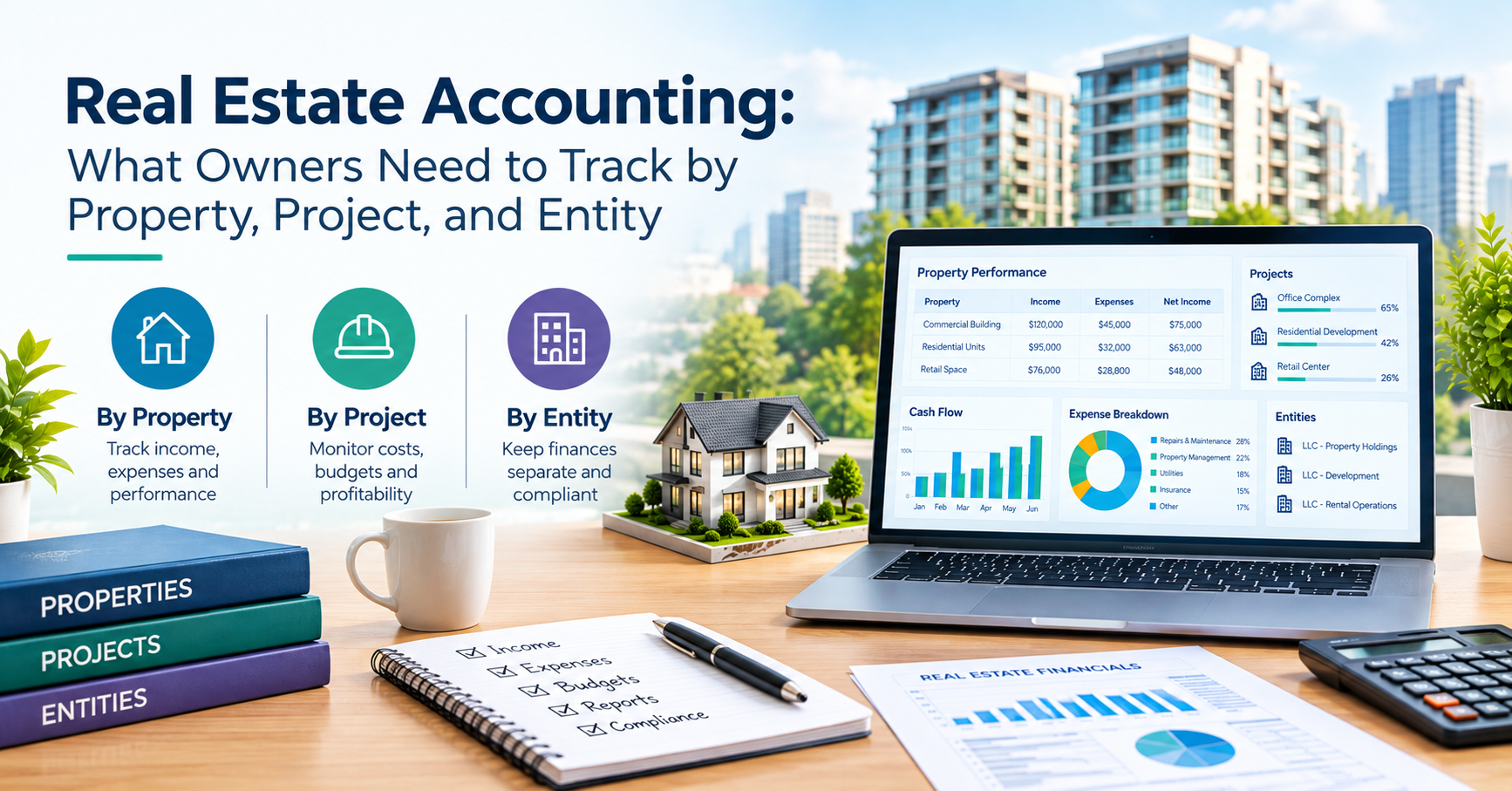

What these businesses share is the need for real estate accounting that tracks financial activity at the level where decisions are actually made—by property, project, and legal entity.
Real estate businesses do not all receive cash or recognize income in the same way. A rental portfolio may collect recurring monthly rent, while a developer may receive construction-loan draws during a project and sale proceeds when completed units or properties are sold. Effective real estate bookkeeping helps keep these transactions organized and provides a clearer view of income, expenses, project costs, and cash flow.
For real estate investors, rental-property owners, and small developers, generic bookkeeping approaches often fall short. The gaps show up exactly when clarity matters most: at acquisition, at refinancing, or when deciding whether a project is still on budget.
Many real estate businesses find that a standard bookkeeping setup doesn't reflect what's really going on financially. Common gaps include:
A one-size-fits-all bookkeeping setup often fails to provide the property-, project-, and entity-level information real estate owners need. Standard accounting methods aren't the problem an inadequate chart of accounts, tracking structure, or reporting process usually is.
Real estate decisions tend to be large and hard to reverse: buying a property, starting a project, taking on financing, bringing in a partner. These decisions deserve financial data that's specific, not general.
When these details blur together, it becomes difficult to know which properties or projects are actually performing. Without property-level or entity-level clarity, an owner might see healthy overall numbers while one property quietly loses money, or miss that a project's true cost has crept past budget. Clear, structured accounting turns a broad financial picture into something an owner can act on answering questions like which properties are producing cash, which are underperforming, whether a project is staying within budget, how debt is affecting cash flow, and whether the portfolio can support another acquisition.
Income and expenses should be tracked by property or project and, where useful, by unit. Tracking every expense at the individual unit level may not be practical or necessary for every portfolio, but performance should always be visible at the property or project level — not just rolled into one overall total. For development projects, this may also include construction-in-progress costs, committed costs, loan-draw activity, and budget-to-actual reporting.
Repairs, routine maintenance, and capital improvements can affect operating results, property basis, depreciation, and taxes differently. The distinction isn't simply routine versus long-term it depends on the facts and circumstances of the work performed. Under the federal tangible-property rules, an expenditure may need to be capitalized when it results in a betterment, restoration, or adaptation to a new or different use, while other repairs and maintenance may be currently deductible. These costs should be reviewed and classified based on the nature of the work and applicable accounting and tax rules, not placed into one general repair category.
Loan principal, interest, and escrow activity should be recorded separately rather than combined into one mortgage expense. Principal reduces the outstanding debt balance. Interest may be expensed or capitalized depending on the property, project, and applicable accounting and tax rules. Amounts deposited into escrow should be tracked separately from the taxes, insurance, or other obligations ultimately paid from the escrow account.
Each legal entity should maintain accurate, separate books and records. Owners may also need combined portfolio-level management reporting to understand total cash, debt, profitability, and property performance across the organization. This is a distinct concept from formal financial-statement consolidation, which has a specific accounting meaning and generally requires an analysis of control, voting interests, and other factors.
Multi-entity real estate businesses frequently have cash transferred between LLCs, expenses paid by one entity on behalf of another, owner contributions and distributions, due-to and due-from balances, shared administrative costs, and management fees between related companies. Transfers between related entities, owner contributions, distributions, and shared expenses should be recorded consistently. Moving money from one LLC to another is not automatically revenue to one entity and an expense to the other — and recording it that way can distort revenue, cash flow, and entity balances across the board.
Tenant security deposits and other funds held on behalf of tenants, owners, or transaction parties generally should not be treated as ordinary operating income. Refundable tenant security deposits generally are not rental income when received if they are expected to be returned; amounts intended to serve as final rent are treated differently. Depending on the business’s role and jurisdiction, these balances may require designated accounts, property- or owner-level ledgers, and regular reconciliations. The appropriate process should be confirmed for the specific situation rather than assumed to be universal.
Beyond day-to-day tracking, a real estate accounting process should preserve the records that support long-term basis and depreciation: purchase price allocations, land versus depreciable building value, capitalized acquisition costs, improvements placed in service, accumulated depreciation, and closing-statement activity. Depreciation generally allows the cost of qualifying depreciable property to be recovered over its applicable recovery period; land itself is not depreciable. Capital improvements should therefore be tracked separately from current operating expenses to support accurate basis records and depreciation schedules.
Real estate transactions can be irregular and significant. A single acquisition, refinancing, capital project, construction draw, or property sale can materially affect cash, debt, and reported results. That makes timely, consistent recordkeeping especially important a missed or delayed transaction can distort the financial picture when substantial amounts are involved.
For real estate business owners looking to strengthen their financial visibility:
At Accounting Expert Group, we recognize that complexity is not an inconvenience to work around it is part of the actual structure of a real estate business, and the accounting system should reflect that structure clearly.
That is why we approach real estate clients with property-, project-, and entity-level detail built in from the beginning rather than added later. Our process may include separate entity books, properly recorded loan and escrow activity, intercompany tracking, property- or project-level reporting, and a combined portfolio-level management view. The goal is not simply to produce clean books. It is to give owners a dependable view of property performance, project costs, debt, cash, and portfolio capacity before the next acquisition, refinancing, or development decision is made.
1. How is real estate accounting different from standard small business accounting? Real estate accounting uses the same core accounting principles as other businesses, but the bookkeeping setup often requires additional tracking by property, project, loan, and legal entity. A generic company-level setup can hide how individual properties or projects are performing.
2. Why does it matter if income and expenses are tracked by property or project instead of overall?
Tracking by property or project helps show which properties are producing income, consuming cash, meeting expectations, or underperforming. Without this detail, healthy results in one part of the portfolio can conceal problems elsewhere.
3. How should repairs, maintenance, and capital improvements be classified?
The treatment depends on the facts and circumstances. Some expenditures may qualify as current repairs or maintenance, while others may need to be capitalized because they improve, restore, or adapt the property. Significant expenditures should therefore be reviewed rather than classified solely from the invoice description, dollar amount, or a general rule of thumb.
4. Do I need separate bookkeeping for each entity if I have multiple LLCs?
Each legal entity should maintain its own accurate books and records. On top of those separate entity records, owners often benefit from a combined portfolio-level management report to understand total cash, debt, and performance across the organization. This management view is different from formally consolidating entities for financial-statement purposes.
5. What financial reports should a real estate owner review each month?
A useful monthly reporting package may include an entity-level balance sheet and income statement, property- or project-level operating results, cash balances, accounts receivable and accounts payable activity as applicable, debt balances, budget-to-actual results, and a summary of major capital expenditures.
6. Are construction-loan draws considered revenue?
A bona fide construction-loan draw is generally recorded as an increase in cash and an increase in the related loan liability, not as operating revenue. The related project costs, interest, and loan activity should be tracked separately so project performance and debt remain clear. Borrowed money through a bona fide loan generally is not income.
If your current financial reports don't show performance by property, project, and entity, it may be time for a bookkeeping and reporting system designed around the way your real estate business actually operates.
Schedule a consultation with Accounting Expert Group to discuss how property-level bookkeeping, accurate entity records, and portfolio-level management reporting can give you a more dependable view of cash flow, profitability, debt, and investment performance.